The three raven chicks are growing fast - already feathered on parts of their bodies. We believe that the eldest of the three is about four weeks old. Still, the parents favour proteine for their young; heart, liver, minced meet, shrimps, fish and eggs is part of their diet. With added vitamins anc calcium. And it seems to do the trick!
http://youtu.be/2Eo_L9QUXCI
fredag 10 maj 2013

fredag 3 maj 2013
Visiting students
Today we were visited by students from the course in Ecology of behaviour/ethology at Lund University. Mathias usually gives some lectures on this course, and the students come for a field trip to the raven facility.
 |
| Without the extra human friendly Siden and Juno, the raven group was a bit more scared of new people, and the students stayed inside the cabin until the birds had calmed down. |

To not disturb the breeding pair, we had sealed off their part of the aviary from the visitors, and it turned out fine. No alarm calls or attacks - they just continued with their time consuming task....feeding their young who seem to grow by the minute!
 |
| Anders Brodin, Professor Evolutionary Ecology (course coordinator) & Mathias |
måndag 29 april 2013
Number of nestlings
For a long time, we have been quite unsure of the number of nestlings. And now, all of a sudden we can easily see all of them when they are being fed. Three hungry beeks stretching upwards...
//Helena
//Helena
torsdag 25 april 2013
Building and painting
Since the breeding season started, we have not been able to work that much with the ravens. Firstly, there is much more group dynamics than usual, which make it harder to interest the them in experimenting. Secondly it's much more difficult to separate them, since Juno and Siden has occupied one whole section of the aviary complex.
Instead, we have put some time and effort into enhancing the facility, and a grant from The Royal Physiographical Society has made it possible to convert a part of an old pig stable into much needed research facilities!
The renovated part will house one area for preparing and keeping raven food, analyzing fecal samples and keeping research equipment.
 We are also constructing a small indoor aviary in case any bird should be injured, or for any reason should need to be kept apart from the others. This aviary could also be used for experiments where sensitive equipment, like an eye-tracker, is used.
 On the second floor (although we don't yet have any stairs) a part of the old hayloft has been converted into a spacious area, suitable for seminars and meetings.
The only downside is that it probably will take ages to paint...
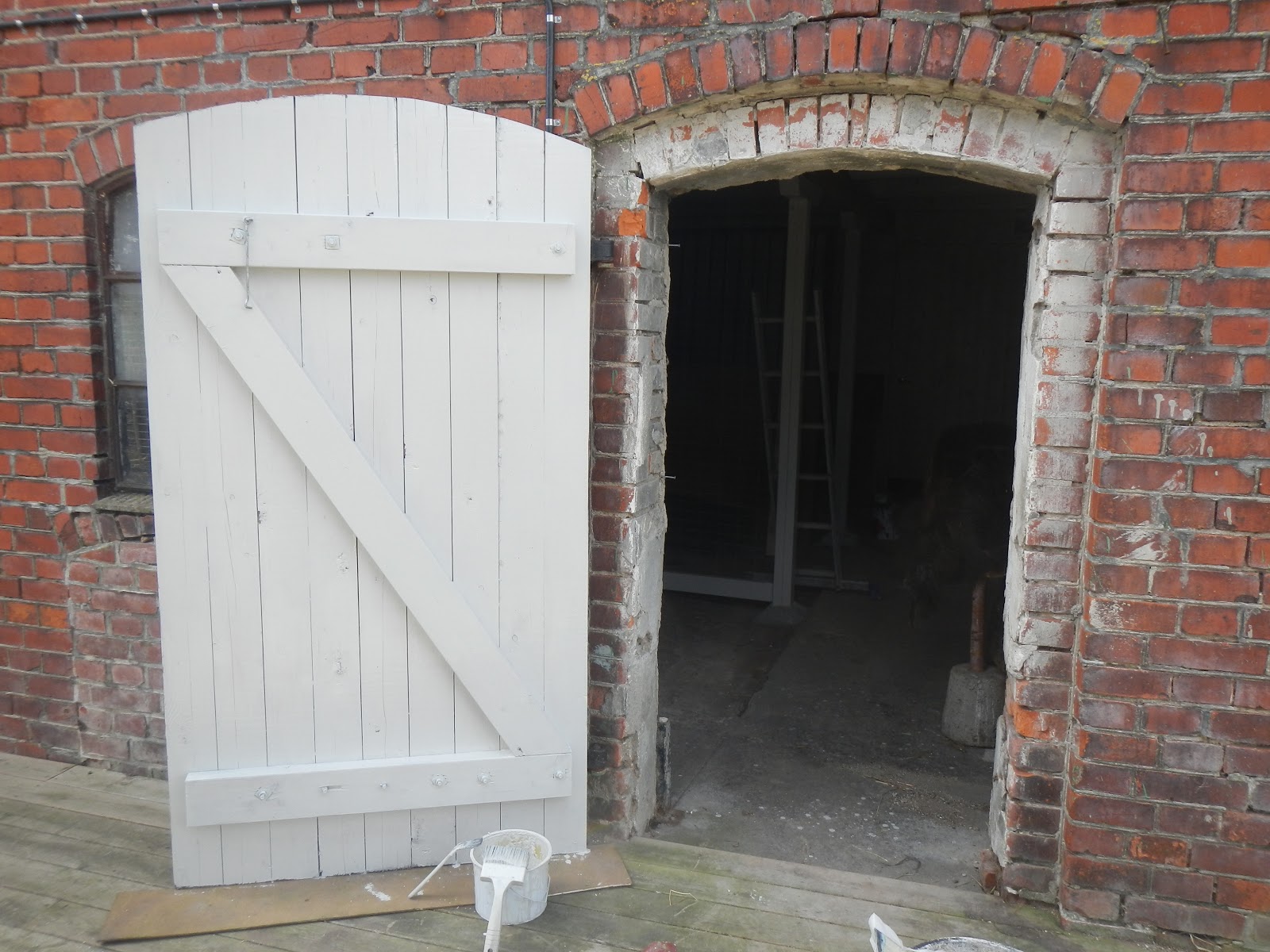 | ||||
| The door to the old pig stable |
 |


The only downside is that it probably will take ages to paint...
onsdag 24 april 2013
Radio documentary on corvid research


tisdag 23 april 2013
Raven chicks
We have
been waiting for Juno to realize that her eggs will not hatch, and that life in
the aviaries should go back to normal again. For ravens it can take several
years before they find a partner and manage to breed successfully. It is quite common
that young raven couples have to practise nest building a few times before the
nest meets the required standard, and also that the female has to learn how to
incubate properly. As far as we know, and we did ask around in the raven
research community, succeeding in raising chicks in the first adult year is
unheard of.
So imagine
our shock, when we heard faint tweets from the nest last week. The eggs had
hatched after all! To make it even more incredible, Siden and Juno are siblings
(if we didn’t mix them up when they were small) and we have never seen them
mating. It is quite common that ravens form sibling pairs during the early
years, or even pairs of the same sex, so that has never been an issue. Moreover,
sibling mating in birds is not totally uncommon, and if they are able to buffer
out the sometimes negative effects of combining closely related genomes, the
strategy can even be rather successful from a biological perspective. On the other hand - if the gene mix should be bad– the eggs
normally wouldn’t hatch. So either, Juno and Siden are not siblings, or Juno
and Rickard has been mating – or the gene combination of the chicks are
perfectly healthy. We will still have to see what happens next.
As soon as
we realized that the eggs had hatched, we ran to the store to buy the best
chick food, extra vitamins and calcium – to provide the young parents with as
nutritious food for their chicks as possible. And they are so capable! When new
food is brought, Siden immediately caches most of the food, and then flies off
to the nest to feed Juno and the chicks. Still, we don’t know if they will
manage to properly care for them, but at least they will have a good chance.
//Helena
Prenumerera på:
Inlägg (Atom)