Organizing
old photos made me once again realize how beautiful ravens are - even
when they are not in mid-air, wings spread. These photos are
all from the first year, when the ravens were less than 6 months old.
They look quite big, but compared to adult ravens the bodies are much
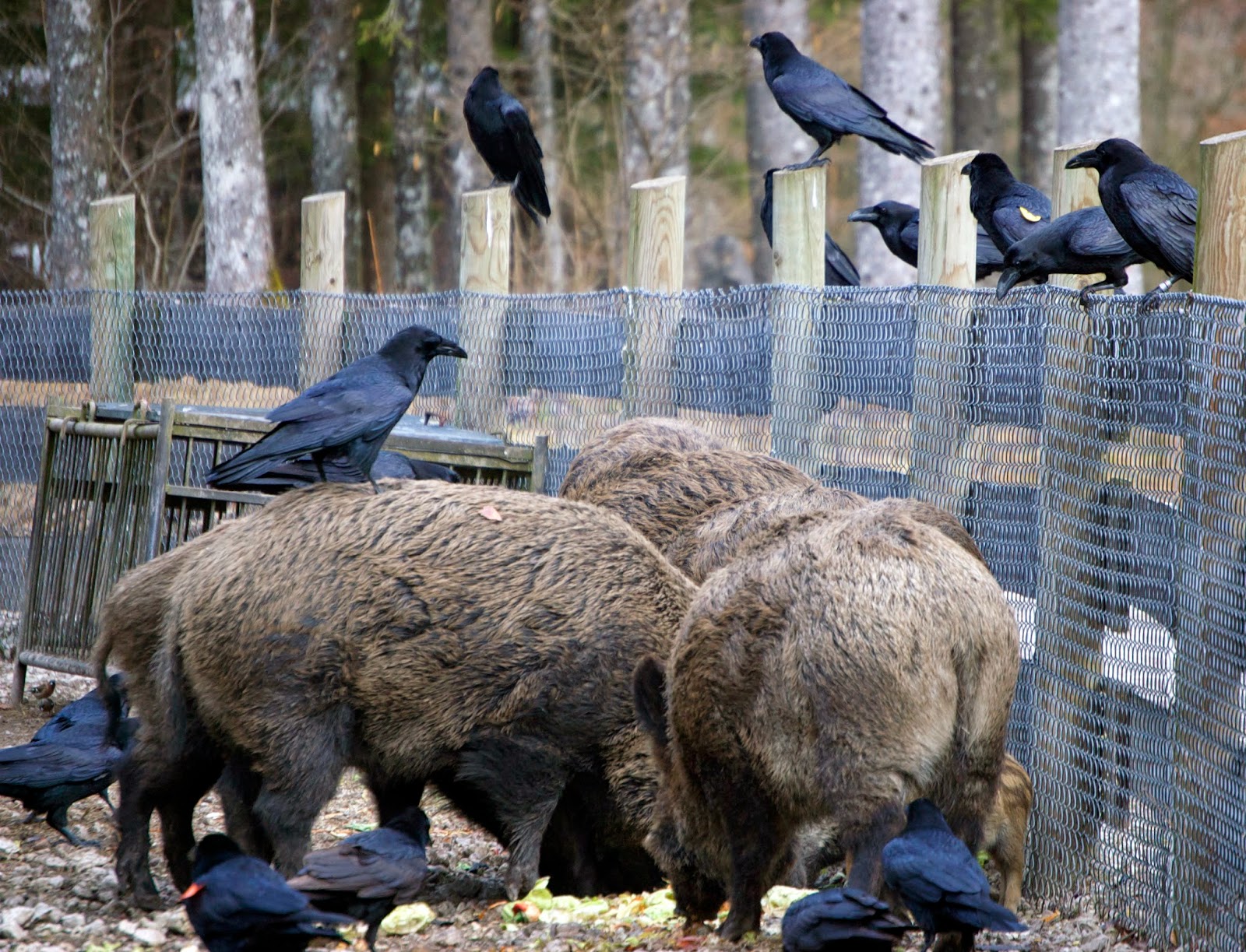
more slender, beaks are thinner and pointier, and and mouths are still pink. The last picture is from the wild park in Grünau, Austria, where much of the wild raven research is done.
måndag 24 november 2014
måndag 17 november 2014
Radio documentary
Last spring, Lotta Malmstedt from the Swedish National Radio, started working on her documentary on our raven research. Around a year ago, she did the last recordnings, and yesterday the 50 minute long documentary was sent on radio P1. Listen to it here!
fredag 7 november 2014
New grant from the Swedish Research Council!
Earlier this week, the Swedish Research Council announced the recievers of their International Career Grants, and Mathias turned out to be one of the twentyfour lucky researchers!
His project "The social
intelligence hypothesis and the episodic memory system – the role of memories
in the social skills of cognitively complex animals" got funding for four years (starting 2015), which includes full-time employment for Mathias, one PhD-student and part-time employment for a research assistant.
The Career grant aims at developing young researchers both as scientists and leaders, in close collaboration with a foreign University - in this case Thomas Bugnyar's group at the Department of Cognitive Biology,
University of Vienna.
The overarching purpose of the project is to
investigate the role of memory systems, in particular episodic memory, in
complex social life, and thereby provide new insights into the evolution of
complex cognition.
The focus will be on ravens as the University of Vienna and Lund University have the only research facilities for studying raven cognition. This enables the project to test effects of different parameters – such as sex, rank, age and population – in a statistically robust way, which is usually very difficult in raven cognition studies - and up to 20-40 raven subjects can be involved in each of the different studies! Chimpanzees will also be added to one of the set ups, as such comparisons are important in understanding the potential parallel evolution of the cognitive skills.
//Helena
torsdag 6 november 2014
Recap summer 2014
Lots of things have happened since my last blog post in May. Maybe the most important thing is that we extended the group with three new wildcaught raven chicks. They all come from nests nearby - the closest only 800 metres away.
Meet Kalle, Embla and Hilda!
Although the nests were so close in range, the age of the chicks differed widely. I had been observing the nests a few times per week ever since the females started sitting on the nests, but as many nests are quite deep, and also located high up it's difficult to get a glimpse of the chicks in order to determine their age. The youngest was barely 2 weeks old, and we named him Kalle, since he looked like Donald Duck (Kalle Anka in Swedish) when he first arrived.
The PhD students - Ivo and Can- were busy all summer documenting the developmental stages of the young, which will later result in a paper on the cognitive development in raven chicks. At the moment all other ravens are also taking part in different studies on planning and physical cognition.
During summer, two new papers were published; "The future of future-oriented cognition in non-humans: theory and the empirical case of the great apes" (Osvath & Martin-Ordas)
and
"Independent evolution of similar complex cognitive skills : the importance of embodieddegrees of freedom"(Osvath, Kabadayi & Jacobs)
Mathias also participated in the Social Brain Conference in Copenhagen, contributing with a poster on the contagious play study. The conference hosted several world leading experts on social cognition and its relation to the brain. The participants formed a mix of neurobiologists and animal cognition researchers - a fruitful combination.
After summer we welcomed a new member of the group - master student Russel Reiter. He will take several courses at the station, and most importantly write his master's thesis here on raven cognition.
In mid October we had our yearly cleaning day of the station, and also the inauguration of the seminar room on the second floor - the "Hugin Hall". When the department of Cognitive Science moved from Kungshuset to the new LUX-house a lot of furniture was left behind - enough to furnish the station's lecture hall, so now we are ready for lectures, symposiums and courses!
//Helena
Meet Kalle, Embla and Hilda!
![]() |
| Kalle, Embla and Hilda |
![]() |
| Kalle |
During summer, two new papers were published; "The future of future-oriented cognition in non-humans: theory and the empirical case of the great apes" (Osvath & Martin-Ordas)
and
"Independent evolution of similar complex cognitive skills : the importance of embodieddegrees of freedom"(Osvath, Kabadayi & Jacobs)
Mathias also participated in the Social Brain Conference in Copenhagen, contributing with a poster on the contagious play study. The conference hosted several world leading experts on social cognition and its relation to the brain. The participants formed a mix of neurobiologists and animal cognition researchers - a fruitful combination.
After summer we welcomed a new member of the group - master student Russel Reiter. He will take several courses at the station, and most importantly write his master's thesis here on raven cognition.
| The seminar room. |
In mid October we had our yearly cleaning day of the station, and also the inauguration of the seminar room on the second floor - the "Hugin Hall". When the department of Cognitive Science moved from Kungshuset to the new LUX-house a lot of furniture was left behind - enough to furnish the station's lecture hall, so now we are ready for lectures, symposiums and courses!
| The cosy corner. |
//Helena
torsdag 22 maj 2014
Two new publications on raven play!
In May's issue of Animal Behaviour and Cognition, we have contributed with no less than two papers - both on raven play.
"An exploration of Play Behaviours in Raven Nestlings" (Osvath, Osvath & Båth) is study of the nestlings from last year, where we analyzed almost 20 hours of nest activity - discovering that the chicks actually spent equal or more time playing in the nest than on maintenance behaviors and flight training.
"Sub-adult Ravens Sunchronize their play: A Case of Emotional Contagion" (Osvath & Sima) is a study on the sub-adult ravens which explored instances of contagious behaviors within the play domain.The results indicate emotional contagion: the birds engaged in all categories of play on a higher level under the condition where contagion was likely to occur. This type of contagion is thought of as a key phenomena in the development of advanced social cognition in humans. This is the first time ever it has been shown in birds.
//Helena
Empty nest
In the end, the number of nestlings turned out to be four, and after weeks and weeks of feeding them in the nest it was finally time to fledge!
The first chick, presumably a female, fledged on May 15th and the second chick, which we think is a male, one day later.The last two nestlings seemed almost surprised, watching the comotion on the ground from above. But two days later, on May 18th, they decided it was time to go.
After the incident last year when the unexperienced parents pulled out several tail feathers when trying to drag the first fledglings back to the nest, we feared that something similar would happen this year. But although a bit distressed when the chicks are too spread out in the aviary, Siden seems to have learnt from last year. Still, he sometimes tries to drag or pull his young to areas he consider"safe" - but all feathers are intact.
When Siden has a say, all four chicks sits safely in the dead old elder tree, which serves as a perfect playpen to new-fledged ravens.
onsdag 23 april 2014
The annual site visit
Since some years back, Mathias is lecturing on the course Ecology of behaviour/ethology given at Lund University's Biology department. As a part of the course, the students visit the raven facility to conduct an assignment "in the field". Usually the task is to establish the dominace hierarchy among the ravens, but as we have them separeted in three different aviaries during breeding season, there isn't much hierachy to observe. Instead the students were assigned to construct a so called ethogram, which, shortly put, is a behavioral catalogue of a species.
//Helena
Photo: Can Kabadayi
Prenumerera på:
Inlägg (Atom)